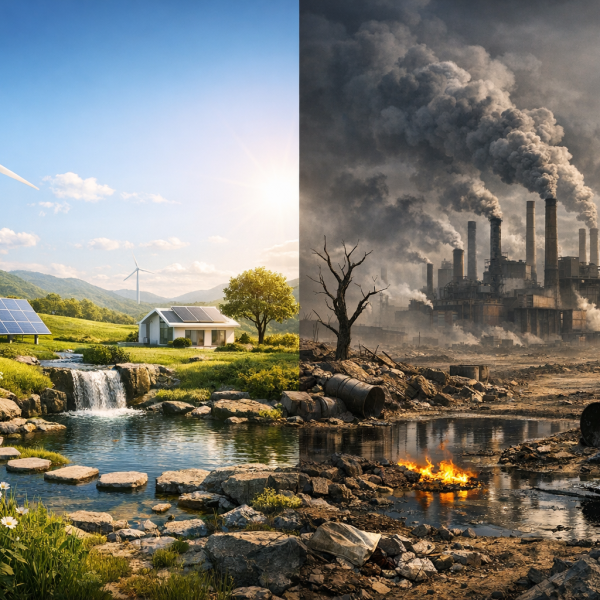
Green growth, net-zero pledges, and climate-smart innovation are now at the center of corporate and governmental messaging. Everywhere you look, brands claim to be “eco-friendly,” cities claim to be “carbon-neutral by 2050,” and investors talk about “sustainable portfolios.” On the surface, it feels as if a powerful green transformation is underway. But when we dig deeper into how energy is produced, how products are made, and how money actually moves, a more complicated picture emerges.
1. The Promise: Clean Energy Taking Over
The dominant narrative is that solar, wind, and other renewables are rapidly displacing fossil fuels. Governments highlight record solar installations, corporations purchase green power credits, and consumers are encouraged to feel that the grid is quickly decarbonizing. Marketing departments talk about “running on 100% clean energy,” implying that the era of coal, oil, and gas is nearly over.
In reality, total global energy demand keeps rising faster than renewables can scale. Fossil fuels still supply the bulk of primary energy worldwide, and many “100% renewable” claims rely on accounting mechanisms and offsets rather than actual physical replacement of fossil generation. New wind farms and solar parks are indeed crucial, but they often sit on top of an expanding fossil baseline rather than truly shrinking it. The result is a slower and more uneven transition than public messaging suggests.
2. The Promise: Green Products and Ethical Brands
The consumer marketplace has been flooded with eco-labels: sustainable, natural, biodegradable, carbon-neutral. Companies promise guilt-free shopping, claiming that you can continue to consume at high levels because their supply chains are green and their packaging is planet-friendly. Influencers promote “low-impact” lifestyles that still depend on high volumes of new goods shipped around the globe.
The gap between branding and reality is wide. Many “green” claims are vague, unverified, or based on narrow metrics that ignore the full lifecycle impact of a product. Packaging may be recyclable in theory, but infrastructure to process it is often missing. “Sustainable” raw materials may still be linked to biodiversity loss, local pollution, or labor exploitation. This creates a market where appearance often matters more than measurable environmental outcomes, and where genuine low-impact alternatives struggle to compete with heavily marketed, only partially green products.
3. The Promise: Sustainable Growth and Win–Win Economics
Policymakers frequently argue that we can decarbonize while maintaining or even accelerating economic growth. The idea is that technological innovation and efficiency gains will allow us to “do more with less,” decoupling economic output from environmental damage. Expanding sectors like clean tech, circular economy services, and low-carbon infrastructure are promoted as engines of job creation and prosperity.
The implementation, however, shows deep trade-offs. Many supposed efficiencies are offset by rebound effects, where cheaper, cleaner technologies lead to increased total consumption. At a macro level, material extraction, global freight, and manufacturing continue to expand, driving emissions and ecosystem pressures higher. Businesses that genuinely prioritize long-term sustainability often face higher upfront costs and slower returns, while those that externalize environmental damage remain highly competitive. This is why companies working to strengthen their digital presence strategically, including through efforts to buy website backlinks, emphasize transparency and evidence-based communication to stand out from superficial green messaging.
4. The Promise: Corporate Net-Zero Pledges
Thousands of corporations have announced net-zero targets, often accompanied by glossy sustainability reports and high-profile campaigns. These pledges suggest that the private sector is aligning itself with climate science, committing to steep emissions reductions by mid-century or sooner. Shareholders, employees, and customers are encouraged to see these commitments as proof of serious environmental responsibility. Investing in professional seo services helps a site earn steady, long-term organic traffic.
On closer inspection, many of these plans are light on near-term actions and heavy on long-term hopes. A large share of “net-zero” relies on offsets, future carbon removal technologies, or land-use assumptions that may not be realistic at scale. Short-term investment decisions often still favor fossil fuel expansion, high-carbon products, and disposable design. Metrics are cherry-picked, with scope 3 emissions, supply chain impacts, and end-of-life responsibilities frequently underreported or sidelined. This creates a credibility gap between visionary climate pledges and the concrete, year-by-year operational changes needed to achieve them.
Verification is the recurring weakness in green claims, since almost everything depends on records that are difficult for outsiders to audit. Distributed ledgers have been proposed as a fix for precisely this, with decidedly mixed results so far. Following blockchain innovation is worthwhile if only to see which of those claims survive contact with practice.
5. The Promise: Circular Economy and Waste Reduction
The circular economy concept has gained immense traction. Companies and cities tout recycling programs, take-back schemes, and “closed-loop” models that aim to keep materials in use and out of landfills. The message is optimistic: with smart design and better logistics, we can significantly reduce waste and resource extraction while maintaining current consumption patterns.
The practical outcomes are more modest. Global waste volumes continue to grow, and recycling rates for many materials remain low. Complex products, mixed materials, and the economics of waste management make genuine circularity difficult at scale. Many take-back programs are small pilots rather than core business models. Meanwhile, fast fashion, electronics turnover, and disposable packaging still dominate. Without structural changes to production volumes, product design, and consumer expectations, circular initiatives risk becoming incremental improvements overshadowed by ever-rising throughput.
6. The Promise: Green Finance and ESG Investing
Financial markets now feature a vast ecosystem of “green” funds and ESG (Environmental, Social, Governance) products. Investors are told they can align their portfolios with their values and support climate solutions without sacrificing returns. Banks, asset managers, and insurers promote sustainability frameworks and stewardship policies as proof that capital is flowing away from harmful sectors and into regenerative ones.
Yet much of green finance still struggles with inconsistent standards, weak metrics, and limited transparency. ESG scores often diverge significantly between rating agencies, and funds marketed as sustainable may hold major stakes in fossil fuel companies or high-impact industries. The volume of capital in genuinely transformative projects, such as deep energy retrofits, regenerative agriculture, or community-scale infrastructure, remains relatively small compared with overall financial flows. In many cases, “green” products offer more reputational benefit to institutions than measurable environmental progress on the ground.
From Promises to Measurable Progress
The tension between the aspirational story of a thriving green economy and the slower, more uneven reality is not a reason for cynicism; it is a call for precision, accountability, and honesty. Meaningful change demands more than clever branding and long-dated targets. It requires clear metrics, independent verification, and business models that genuinely prioritize environmental integrity over short-term gains.
For organizations, this means aligning strategy, operations, and communication with what they can actually deliver. For policymakers, it means designing regulations and incentives that close loopholes and reward real performance, not just promises. And for consumers, investors, and citizens, it means looking beyond slogans, asking for evidence, and supporting those actors that demonstrate tangible, verifiable progress.
The potential of a truly sustainable economy remains enormous, but it will only be realized when the narrative matches the numbers. That shift starts with replacing aspirational stories with transparent data, hard choices, and a willingness to rethink how value is created, measured, and shared in a resource-constrained world.